Monday, 8 May 1972. A date that has gone into the annals as one of the most significant and infamous in the 150-plus years of organised English league football ended with Derby County crowned unlikely league champions. An evening of unprecedented drama saw Leeds United denied a league and FA Cup double at the death. In contrast, a last-minute Liverpool ‘goal’ at Highbury, which would have given the Anfield men their eighth league title, was controversially ruled out.
Before we trail through the details of that balmy spring evening over half a decade ago, a look back at the 1971-72 season in context is highly recommended.
The season had kicked off with Arsenal, the defending champions, having pipped Leeds United to the 1970-71 title in controversial circumstances. Leeds had suffered from a contentious refereeing decision in a late-season home defeat by West Bromwich Albion that had proved costly, and some of the club’s more enthusiastic – shall we say -supporters had expressed their displeasure by way of staging a pitch invasion. The Football League had taken a dim view of such contretemps and had ordered Leeds to play the first four home games of the 1971-72 season away from Elland Road. This had proven costly, as Leeds had dropped points in these games.
Broadly speaking, it had been a gung-ho of a season with any one of four sides in with a chance of the title right up to the last weeks of the season, and as implied above, three still in with a shout until the last kick of the campaign. Manchester United, under the leadership of Frank O’ Farrell, had made most of the early running and were clear at the top going into the New Year.
Poor form after the Christmas lights came down saw the Old Trafford team fade away, and for a long while, it looked as if it would be their noisy neighbours, Manchester City, who would take the title for the second time in four years. Led by Malcolm Allison, who had jettisoned manager Joe Mercer from power, City were playing expansive football and looked like a shoo-in for the crown. It was then that Allison made what many considered to be a fatal mistake by signing the mercurial Rodney Marsh. Although undoubtedly talented, Marsh upset the cohesion of the Maine Road side, and their form began to slip away.
So, it came to pass that the destiny of the title would be in the hands of proceedings at Highbury and Molyneux, homes of Arsenal, who would be hosting Liverpool, and Wolves, who would be welcoming Don Revie’s Leeds United to town, respectively. Sitting atop the table were Derby County, who had completed their league season a week earlier with a single-goal victory over Liverpool and were now on holiday in Spain on an end-of-season break.
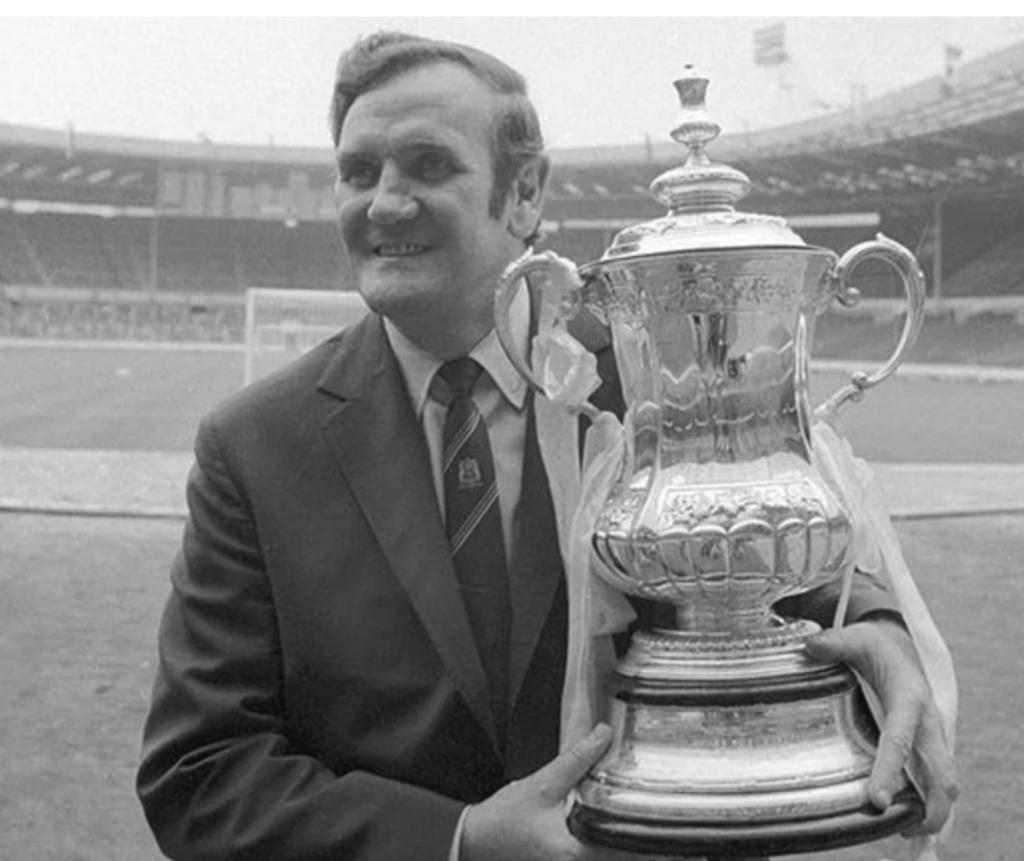
To hold onto top spot, Derby had to hope that Leeds would be defeated by Wolverhampton, while Liverpool would fail to win at Arsenal. To add to the intrigue, Leeds were looking to complete the league and FA Cup double, having defeated Arsenal at Wembley in the cup final barely 48 hours earlier. For Wolves, this was far from an end-of-season dead rubber either, coming as it did amid an all-England UEFA Cup Final mash-up with Tottenham Hotspur.
Despite the undoubted fatigue of the previous weekend, Leeds were heavy favourites to grab at least the point that would bring the title back to Elland Road for the second time in four seasons.
As both matches kicked off, the league table looked thus:

From the outset, Leeds took the game to Wolves in an attempt to make an early and potentially decisive breakthrough. Bremner went close early on, and then Allan Clarke appeared to be fouled by Wolves ‘keeper, Phil Parkes, but the referee waved away Leeds’ appeals for a spot kick.
In front of a season-best attendance of 53,379, Wolves attempted to find a foothold in the game but were lucky to survive an even more contentious penalty appeal after 25 minutes when defender Bernard Shaw appeared to use both hands to claw away another effort by Clarke.
Intense Leeds’ pressure could not force a breakthrough, and two minutes before half-time, the inevitable happened. From Wolves’ second corner of the night, the ball was only half cleared, and Wolves’ Munro slammed home through a crowd of players. Leeds went in at half-time a goal down, but by no means out of the match or the title hunt

Over at Highbury, the travelling Liverpool support greeted news of the Wolves’ goal with delight and used it to attempt to drive their team forward. The truth was, however, that nothing much of any note was happening in North London. For a side that needed to win to stand any chance of taking the title, Liverpool were not pulling up any trees and seemed content to spend most of the first half on the back foot and playing on the break, with the result that half-time came and went with the scoreline blank.
Back at Molyneux, the second half was underway. Lorimer went close with a fierce free kick early on, and then Leeds started to turn the screw. Wave after wave of attack fell down on the home side’s defence, yet Leeds were unable to grab the all-important breakthrough. As they poured forward, more and more gaps were opening up at the other end of the pitch, and Harvey in the Leeds goal was called upon on several occasions to keep Revie’s men in the match.
With 67 minutes gone, something had to give, and unfortunately for the men in all-white, they were once more on the receiving end. A sweeping Wolves break ended with stalwart Derek Dougan converting a Richards’ cross to seemingly put the match and the title out of Leeds’ grasp.
Don Revie had other ideas and ordered his men forward, forgetting all pretence at defence now. With Jack Charlton and Billy Bremner pushed right up front, Leeds were not giving up, and when Bremner smashed one home straight after kick-off, the Great Escape was back on.
By now, things were heating up at Highbury with everyone in the near 40,000 attendance seemingly aware of events in the Midlands. With no love lost for Leeds amongst certain sections of the home support at Highbury, the famous old ground was witnessing the unprecedented sight of two-thirds of the attendance cheering for the opponents. First Hughes went close for Liverpool, then Heighway, Keegan, Hall and especially Toshack, but still the Arsenal goal remained intact.
Into the last few minutes of both matches now, and as things stood, Derby County were going to be crowned champions unless either Liverpool or Leeds could score right at the death.
At Molyneux, Terry Yorath thought he had grabbed it at the death when his looping header cleared Parkes in goal, only for Taylor to head the ball off the line.
Time for one more Liverpool charge at Highbury, and when Welshman John Toshack put the ball in the Arsenal net, approximately 30,000 fans roared their approval – only for the referee to signal for offside and chalk the goal off.
Shortly afterwards, two final whistles blew, and Derby County, sunning themselves on holiday, were crowned champions for the first time.
The final table:.

Amidst the disappointment felt by Liverpool and Leeds – some might say ‘sour grapes’ – both sides’ managers complained long and hard about decisions given against their sides on the night. Revie felt Leeds should have been awarded at least two penalties, while Bill Shankly of Liverpool was resolute in his convictions about the legality of Toshack’s last-minute ‘winner’.
Not that it mattered in the end, as nothing was going to change either result and both Shankly and Revie would bounce back from these setbacks by leading their sides to the next two league titles, in 1973 and 1974, before the title once again reverted back to Derby in 1975.
As an aside, in later years, both the matches played out on this date would come under scrutiny amidst allegations of attempted match-fixing. Most famously – or infamously – allegations came to light five years later that Don Revie had been behind an approach to some Wolves players to ‘take things easy’. Several players on both sides were named as allegations, and denials went backwards and forwards before Billy Bremner won a libel suit against the Sunday Mirror for printing the allegations.
Forty years after the match, Liverpool’s captain on the night, Tommy Smith, wrote his autobiography and in it claimed his teammate, and sworn enemy, Emlyn Hughes had approached him and another Liverpool player, Ian Callaghan, before the game saying that unnamed Arsenal players had indicated they would be willing to take the foot off the gas if conditions were right. According to Smith, Hughes had asked him for advice as to what to do, but Smith hadn’t believed him and so nothing had been done at all.
The tawdry and, it should be said, totally unproven, allegations should not take away any of the shine of what was undoubtedly one of the most exciting nights in English football history.
 Site Title
Leave a comment